
Chapter 30: Dissident
: disagreeing especially with an established religious or political system, organization, or belief

Around this time, Gabe was struggling to get going in online school and Aster was going through a major burnout after graduating from high school in June. I struggled to meet their needs while trying to figure out my crap.
As Josh was going through his intense therapy, the mental stress became too much for him so he got a few weeks of medical leave, and then in September his 10-week paid sabbatical started.
I know a 10-week paid sabbatical sounds fantastic, but it also has its cons, as we learned from previous sabbaticals. Too much time at home (in addition to too much together time in 2020) made Josh a little stir crazy so he started going on long drives to get outside and process all he was going through in therapy. He drove all around the beautiful mountains and valleys of northwest Oregon and made pit stops to go on walks in nature and write in his journal.
And just to really lean into the midlife-crisis cliché, he even bought himself a little Miata sportscar for his drives.

I also tried to find fun things to do to keep sane, including family outings. But it seemed that as our personal and marital conflicts rose, so did the chance Josh would be triggered into an emotional meltdown during our outings. I really tried to forget about that possibility because I just wanted us to spend time together.
So our outings that fall were both fun and terrible. The day trip to the beach. The Alanis Morissette concert. The Fruit Loop drive around Mount Hood for my birthday. Setting up for a Relief Society paint night. On the way to and on the way back from my retreat at the end of October. All partly good events, but tarnished by Josh’s meltdowns. It was only in the years after we separated that I realized how emotionally straining those episodes were for me and my children during our entire marriage.
There was so much much stress going on that I was so happy to go on a trip with my mom and one of my sisters to Whidbey Island from September 26-October 2nd.
Mom wanted the experience of riding the train from Eugene to Seattle, so I rode with her, enjoying the comfortable ride and beautiful scenery. We chatted, napped and ate some snacks. We talked about my anger towards the church on the train ride, but only a little bit. I held back because I didn’t want to hurt her feelings about the church she loves so much. I assured Mom that I had no plans of leaving the church, because I didn’t. I truly believed that somehow God would resolve all of my spiritual conflicts and lead me back to being a true-believing and valiant Mormon.
We rented a beautiful home overlooking Puget Sound. It was such a lovely setting. A welcome respite. We spent the next few days relaxing, talking, laughing and going on outings in the area.


During one of the afternoons we wandered through some shops in downtown Langley and ate a delicious meal at the Braeburn Restaurant. We perused through the Moonraker Bookstore where I hoped to buy a book from a local writer. I found the book The Sacred Ordinary: the Odyssey of a Ninety-one-year-old Contemplative, by Urashan.1 I was drawn in by the author’s unique name and by the description of the book on the back cover:
From the Author: This is a book that’s not about one thing, such as old stories, or spirituality, or how to think, or how to feel better. This is my life, ninety-one years of it. It is what I was and what I have become—my ancestral roots, the family I grew up with, the family I nourished, the places that nourished me; it is what I explored—how I became a contemplative, the music I heard, the visions I saw, what I dreamed, how I’ve lived as a woman during nine decades of this evolution of our culture. It is about dying—giving up embodied spirit—which, like art and music, is all at once wholly sensuous, physical, and spiritual…It is about the way of the sacred ordinary. It is about how I loved. It is about how I love. Skip what you will. Don’t agree with me. Go look for yourself. Live your own sacred ordinary. Remember. Remember who you are. — Urashan
Little did I know that her book, insights, wisdom and life experiences would help me get through my divorce the following year.
One day my sister and I went to Earth Sanctuary, a beautiful, peaceful outdoor space for spiritual connection and meditation. The sanctuary’s forested paths led to Tibetan prayer wheels, stacked stone cairns, calm ponds, the Dolmen Megalith, a labyrinth, Cottonwood Stone Circle and an authentic native american medicine wheel. We felt wonder and honor in those sacred spaces, each centered around varying religious practices.


Visiting the medicine wheel was an especially moving experience. It is located on top of a small hill, surrounded by tall trees and shrubs, and was created and blessed in ceremony by Klaw-osht, a Shaman of the Nuu-chan-nulth tribe from Vancouver Island. To honor that sacred site, participants are instructed to use only Native American prayer protocol and materials while in the wheel, and refrain from taking photos. According to the Sanctuary’s website:
“The Medicine Wheel, one of the most powerful and cherished symbols of Native American belief, is an ancient place of prayer sacred to Native Americans, symbolizing the totality of existence. The Earth Sanctuary Medicine Wheel is a sacred space designed to amplify the power of prayers and connect you with all the Grandmothers, Grandfathers, Mother Earth, Moon, Sun, Sky, and the Creator, on the eternal circle of life.”
And so my sister and I removed our shoes and socks in the silent, drizzling rain and each took our turn walking barefoot through the medicine wheel and offering up prayers. It was such a beautiful experience and a reminder of what indigenous people have known for centuries - that nature is sacred and healing and we are forever connected to all creation and our ancestors.
All in all, our Whidbey Island trip was wonderful and I loved spending time with my sister and mom. I’m also pretty sure I could be perfectly happy living in a little house overlooking Puget Sound for a long time.
When I got back from that trip, I was happy to see Josh and the kids and for the good things that were happening in October.
I found a new therapist and was looking forward to working with them. I had so many emotions to process that had come out of me while intuitive painting for several months. During our initial visit, the therapist said something like “it sounds like where you are isn’t working for you anymore, and you know you want to move away from that but don’t know how to get there.” Yep. This wonderful therapist guided me through the next four years of darkness and I wouldn’t be here without them.
I also renewed my temple recommend. That may seem weird given all I have written so far, but at the time I still believed or at least was trying to believe everything about the church. And I loved the temple.
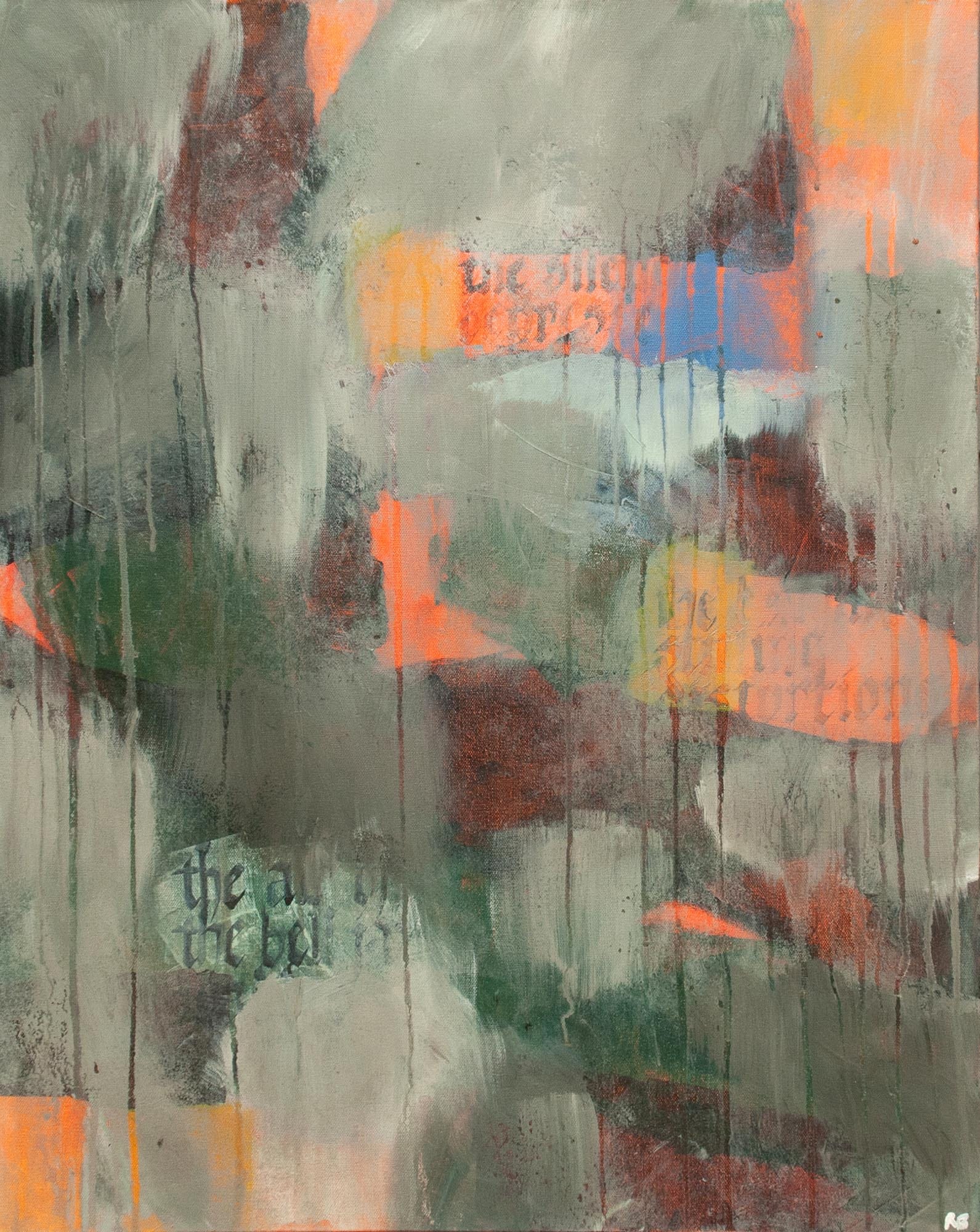
With all of my emotional and spiritual pain, I was catching glimpses of understanding about the correlation between my religious upbringing and my mental health. That prompted me to paint the piece called “My Bell Jar,” about the first time I realized that I had depression. That was during my junior year of high school, when we read The Bell Jar by Sylvia Plath2 for my Women in Literature class. I recognized myself in Esther, the main protagonist, and that terrified me. I kept it to myself. I had no idea how to talk about it then. And frankly I was ashamed to admit it to anyone.
On October 22nd, I was so happy to go out to dinner with many friends to celebrate my 50th birthday. We went to Mother’s Bistro, my favorite Portland restaurant, and enjoyed good food, lots of laughs, and the crowd of fun-loving, kilt-wearing people walking past the big windows of the restaurant. So Portland.


I really needed that birthday dinner with my friends. I was overwhelmed, drowning in my spiritual crisis and family stress. I remember feeling that this all must be happening to lead me to growth and change, but I simultaneously felt like I was losing my mind. I jokingly tell people that I thought I would have everything figured out by the time I turned 50, but as it turns out, that’s the year that everything went to shit.
“When Sleeping Beauty wakes up, she is almost fifty years old.” - Maxine Kumin
Earlier in the month of October, I started reading The Dance of the Dissident Daughter by Sue Monk Kidd.3 I don’t know how to properly explain what this book did for me. As you can tell by the dog-eared pages, underlines, highlights and post-it notes, I was deeply impacted and validated by Kidd’s writing.


According to Merriam-Webster, dissident as an adjective means:
: disagreeing especially with an established religious or political system, organization, or belief
Me? A dissident daughter? I never in a million years thought I would become that.
But there I was recognizing myself in Kidd’s story.
“I was going along doing everything I “should” have been doing, and then, unexpectedly, I woke up. I collide with patriarchy within my culture, my church, my faith tradition, my marriage and also within myself. And this collision changed everything.” (Pg. 7)
Holy crap. That’s me. Doing all the church things I should, and then a massive collision of everything.
At the beginning of the book, Kidd shares the account of a dream she had, in which she sees herself on a beach, nine months pregnant. She begins to labor by herself. She births a baby girl, and looking at her close for the first time, realizes that she had given birth to herself.
“I knew as a woman I’d been asleep, but I had no idea exactly how. I knew I was waking up, but I didn’t possess a clue about what I might be waking up to. All I knew was that there was this tiny female life inside, some part of me waking up and wanting to be born. She was rousing me out of years of somnambulance, and something had to be done with her.” (pg. 26)
I wondered if all I was going through was a rebirth.
The author writes a lot about the feminine wound, particularly in religion, which I don’t think I had ever understood before. Maybe the fact that I wasn’t even aware of it is exactly the problem.
“I grew up in a patriarchal church, but even how well meaning the brethren are, the structure is a patriarchal one. As a woman I was severed from something deep inside myself, something purely and powerfully feminine. Steeped in a faith tradition that men had named, shaped and directed, I had no alliance with what might be called the Sacred Feminine. I had lost connection to feminine soul.”
I have almost always felt a powerful feminine energy as a woman in Relief Society in the church- whether that be at service activities sewing reusable menstrual pads, visiting a sister in her home, or singing “Love One Another” together in our Sunday meetings. I don’t know that I ever felt inferior as a woman in the church. Even though I struggled with my own self worth, we were always reminded that we were daughters of Heavenly Father and He loves us.
Like the author, I thought of myself as an independent woman, with my own goals, opinions, likes and dislikes. But I was also passive to men in power. I must submit to what the Priesthood leaders say, as was my sisterly duty. I could relate to what the author said here:
“One of the more uncomfortable discoveries I made about myself during this time was a need to prove myself to the father world - my own father, the cultural father, the church father. The powerful male presence.”
Kidd wrote, “What happens to a female when all her life she hears sacred language indirectly, filtered though male terms? What goes on deep inside her when decade after decade she must translate from male experience into female experience and then apply the message to herself?” (pg. 61)
Oof. That was me. It was more important to please the father figure with strict obedience than it was to listen to my own inner knowing. Heck, for most of my life, I didn’t even know inner knowing was a thing. Feeling the Spirit (who is male, according to the Mormon church) and receiving personal revelation was always in relationship to the Father and the Son, and whatever the male church leaders said would please the all-male Godhead. And to make it more complicated, the church always emphasized that you can only feel the Spirit if you are worthy and keep all the commandments.
For at least a year or two I had been feeling a longing to connect to Heavenly Mother and I was getting mad that the brethren so strongly discouraged it. Don’t pray to Heavenly Mother because we don’t know enough about her. She’s too tender to handle our problems. Talk about her but not too much.
I wanted to know Heavenly Mother. I had some things to talk to her about. A lot of things. As I read The Dance of the Dissident Daughter, I was being awakened to the Divine Feminine and longed to understand my connection with her.
Kidd also wrote about her relationship with her husband during her spiritual awakening. He was resistant and sometimes resentful. She often “woke every day to uncertainty about my marriage. We found ourselves standing at the site of a leveled relationship, one we ourselves had purposely collapsed from top to bottom like those old buildings that explosive experts bring down in a cloud of dust and applause in order to make way for new construction.” (pg. 119)
Yeah, that sounded familiar. Kidd explained that marriages are meant to be created and re-created. I could see Josh and I also doing what she did,
“worked to undo the old marriage and create a new one stripped of the old dependencies and patriarchal set up, a growth-inducing relationship that offered each of us freedom to choose and be, that only allowed for but enhanced the soul in each of us.” (pg. 120)
Josh and I were both trying to break out of the familiar patterns of our individual selves, our marriage and our roles. The codependency was strong. But we encouraged each other in our growth and I was hopeful that we would emerge stronger.
Another important thing I learned from the book is that this phase of life - questioning, anger, crashing of identity, and/or spiritual upheaval is actually common. Not only common, but a natural phase of life for the majority of women, particularly in their 40s and 50s. I had no idea. If any other females around me had ever experienced this inner turmoil in midlife, no one talked about it.
In the church, the focus is always about being stalwart, steady, never wavering and that everyone is counting on you. Be obedient. Valiant. A rock. True disciples never waver. Beware of the Nephite Cycle. Just follow the prophet. Stay in the boat. Doubt your doubts.
So in a way, the fact that many of women’s natural and normal life patterns have been dismissed for centuries is a part of the overall feminine wound.
Not to mention that Mother Nature herself models the cycles of rebirth, growth, harvest and hibernation. We really need to listen to her.
A whole lot of pain could be prevented if the church allowed us to talk about healthy human development and the stages of life, and how those correlate to our spiritual growth. But they always seem so afraid that science and actual human experience will compete with their authority, and their patriarchal way of viewing things.
I was in awe as I read more about this “inner knowing” and how Kidd came to realize that her “ultimate authority is the divine voice in my own soul.” (pg. 92) She explains that the moment that a patriarchal daughter decides to follow her own inner guidance is both life-changing and very difficult for her to do.
“What is held over her head is condemnation, even damnation. We’ve been led to believe that leaving the circle of orthodoxy means leaving the realm of truth. Typically the church has considerable stake in our staying in the orthodox circle. It knows if we claim ultimate authority as something in ourselves, as some inchoate voice in our own souls, it has lost all power over us. We have rendered ourselves independent, outside its control.” (Pg. 93)
I was absolutely terrified that my spiritual crisis would jeopardize my eternal salvation, as my frequent nightmares reflected. I had many, many nights tossing and turning and dreaming of being outcast from my family, shunned by the church, dragged down to hell and being burned alive at the Second Coming. I’m serious. It was bad.4
Frankly, this pisses me off. Because you get people like me who go through a spiritual upheaval and are terrified that if they follow what their own soul is telling them to do, to step outside the very orthodoxy that is killing them, they are risking their salvation.
Not only is it ignorant to think that people will always be unquestioning, but it is abusive to tell members that such changing and evolving in your spiritual beliefs is not God’s way. And it’s extra damaging to tell us that there is “No real spirituality, no salvation, no community, no divine substance” outside of the church.” (Pg. 60)
The constant fear of damnation and my inner conflict with the church were the most excruciating parts of my spiritual crisis. The conflict was that I had believed everything that the church taught was true, but then couldn’t understand why God was leading me away from it. Why was the Spirit and what I now know as my divine intuition, causing me to question church teachings? Why would God do this and then condemn me for it? It remained an ultimate conflict in my soul for the next few years.
I took all of this - my wonderings, questions, conflicts, need for connection to the divine feminine, and my increasing anger towards the church - with me on my next trip: a personal spiritual retreat in the beautiful Applegate Valley of Southern Oregon.
“Women grow afraid at this moment because it means giving up a world where everything is neat and safe. In that world we feel secure, taken care of; we know where we’re going. Then we wake up and find the old way doesn’t work, that it no longer fits our identity, that by clinging to it, we’re cutting ourselves off from something profound. But we cling anyway because it’s all we’ve got. We call our desire for security loyalty. We yearn for the something we’ve lost as women, but it’s so unknown, so unbearably unknown. And then one day it all comes down to this: Can we trust ourselves, our inmost selves, our feminine wisdom?” P. 93
Urushan. The Sacred Ordinary: the Odyssey of a Ninety-one-year-old Contemplative; Maris Stella Publishing, 2019
Plath, Sylvia. The Bell Jar. London: Faber and Faber, 1963.
Kidd, Sue Monk. The Dance of the Dissident Daughter: A Woman’s Journey from Christian Tradition to the Sacred Feminine. HarperOne, 2004.
I view things much differently now. I believe that the Gods welcome questioning, discovering, developing, evolving. All the things. I now know that the Gods, the Spirit, the divine, my intuition, the feminine soul, were leading me -slowly and painfully untangling my individual spirituality from the orthodoxy I was once secure in, into a much more healthy way of spirituality for my tender soul.
First time reading your Substack! Your writing reminds me of how I tend to learn. Often life experiences, books, and thoughts happen around the same theme at the same time and then congeal to take a shape you can look at and understand. I’m so glad you are writing about your experiences and honoring your inner voice. I think you are so brave. Much love!
I love you Rachel and I appaud you for your courage to share. When your life seems to unravel no matter what you do and the fact that menopause comes along taking the hormones away that help regulate all emotions well that makes it even harder. You have to focus on what is best for you and your children and follow your heart ❤️